 Ultimate guide
Commercial Construction Lending for Developers: A 2026 Guide
Table of Contents
- What Commercial Construction Lending Is and How It Works
- Commercial Construction Loan Requirements for Developers
- Commercial Construction Loan Rates and Terms
- Construction Loan Draw Schedule and Disbursement Process
- Commercial Construction Loan Application Checklist
- Loan Types and Financing Options for Development Projects
- Capital Stack Strategy and Exit Planning
- Common Mistakes Developers Make in Construction Financing
- Frequently Asked Questions
Last Updated: October 21, 2026
What Commercial Construction Lending Is and How It Works
Commercial construction lending is specialized financing for developing and acquiring income-producing properties: multifamily complexes, office buildings, retail centers, and mixed-use developments.
Construction financing works in phases. Rather than disbursing the entire loan at closing, funds are released in scheduled draws tied to construction milestones.
The timeline matters. Traditional bank committees take 120 days or longer to approve a deal. Commercial construction lenders move faster, focusing on asset value and developer experience rather than months of updated financials.
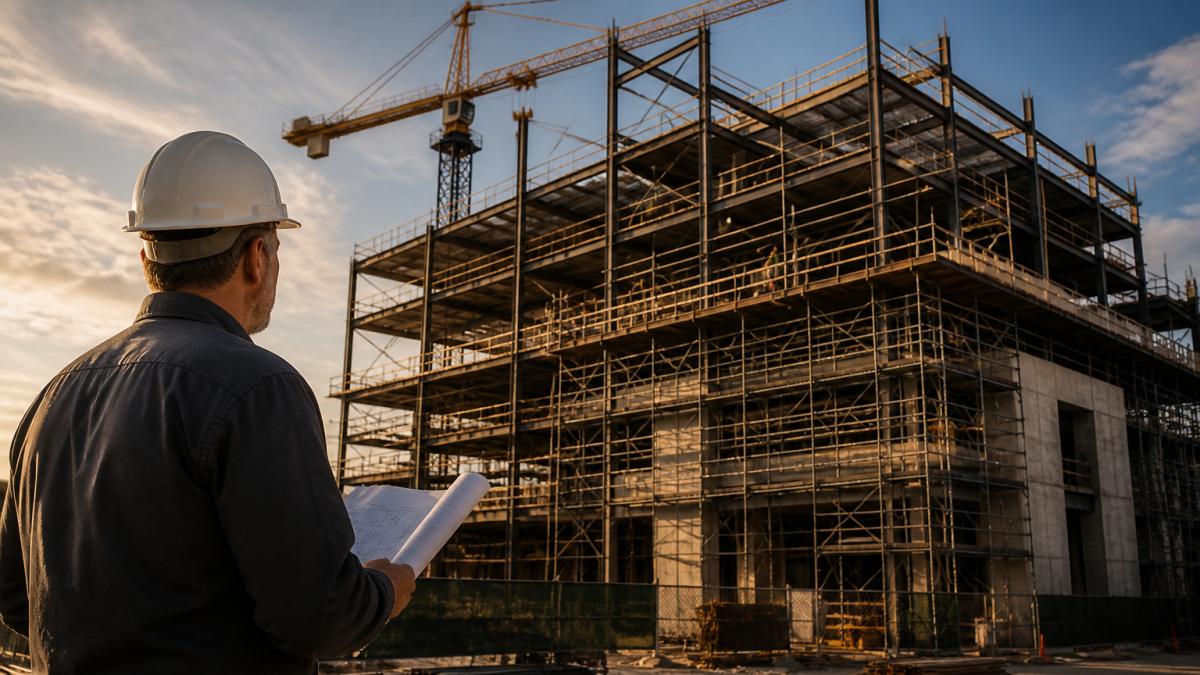
What separates construction lending from permanent financing is the exit strategy.
Commercial Construction Loan Requirements for Developers
Borrower Qualifications and Underwriting Criteria
Construction lenders care about deal experience and asset performance, not W-2 income and tax returns.
The core underwriting question is simple: Has this developer executed similar projects successfully? A sponsor who completed three multifamily developments on time and on budget presents lower risk than a first-time developer, even with higher net worth.
Personal guarantees are standard. Most construction lenders require principals to personally guarantee the loan, so if the project fails, the lender can pursue the developers' personal assets.
Liquidity and net worth matter, but differently than in traditional lending. A developer with $5M in net worth mostly tied up in illiquid real estate is often more attractive than someone with $5M in liquid assets who has never built.
Property and Project Eligibility
Not all properties qualify. The property must be income-producing or have clear income-production potential after development completes. Ground-up construction of a 150-unit multifamily complex qualifies. A value-add renovation of an underperforming office building qualifies. Raw land speculation does not.
Lenders evaluate property type, market, and location. Multifamily housing in supply-constrained markets with strong rent growth is a lower-risk bet than speculative office development in a soft market.
The project must be feasible: stabilized value (the property's value once construction or renovation is complete and leased up) must exceed total project cost by a meaningful margin.
Lenders also examine the development team's and architect's experience. A first-time general contractor on a $50M development raises red flags; an established GC with a completed portfolio reduces construction risk.
Commercial Construction Loan Rates and Terms
Interest rates on construction loans are higher than permanent mortgage rates, typically 200 to 400 basis points above the 10-year Treasury yield, depending on market conditions, project risk, and developer track record.
Most construction loans carry variable rates tied to SOFR (Secured Overnight Financing Rate) or prime.
Loan terms typically run 24 to 36 months, with options to extend if the project hasn't reached stabilization.
Interest reserves are common. Rather than pay interest out of pocket during construction, the developer draws an interest reserve, often 12 to 18 months of projected interest, from loan proceeds.
Origination fees typically range from 1 to 2 percent of the loan amount: a $10M construction loan might carry a $100,000 to $200,000 fee, paid at closing.
Construction Loan Draw Schedule and Disbursement Process
How Construction Draws Work
A construction draw is a request for funds tied to completed work.
The lender's construction inspector or engineer reviews the draw request on site, verifying the work described actually exists: framing complete if framing draws are requested, mechanical rough-in done if mechanical draws are requested. This prevents fraud and ensures funds go to actual construction, not developer expenses.
Once the lender approves the draw, funds are disbursed, typically within 5 to 10 business days. Most lenders disburse to a title company or escrow construction account, not directly to the developer, so the escrow agent releases funds only to the general contractor and approved subcontractors.
Inspection and Lien Waiver Requirements
Lien waivers are critical. Before approving a draw, the lender requires the general contractor and all major subcontractors to sign conditional or unconditional lien waivers stating they've been paid for work completed to date and waiving their right to file a mechanic's lien.
Conditional waivers are most common during construction: the subcontractor waives their lien contingent on receiving payment. Once the check clears, the waiver is final. Unconditional waivers are sometimes required at project completion, confirming all parties have been paid in full.
Inspections happen regularly, often monthly during active construction. The lender's inspector walks the site, reviews the GC's schedule, verifies work is progressing on time, and flags delays, cost overruns, quality concerns, or safety violations.
Commercial Construction Loan Application Checklist
Documentation and Financial Statements
Lenders need proof of the developer's track record and financial strength. Prepare personal and corporate tax returns for the last three years.
Provide a balance sheet showing assets, liabilities, and net worth, plus a list of real estate holdings with current values, outstanding debt, and cash flow. Lenders want to see liquidity and a performing portfolio.
Bank statements for the last 12 months demonstrate cash reserves and the ability to cover contingencies. A developer with $2M in liquid reserves is more attractive than one with $200K, all else equal.
Personal references from previous lenders, contractors, and joint venture partners carry weight. A lender will call your previous construction lender to ask: Did you close on time? Did you pay draws promptly? Were there disputes or cost overruns?
Project Plans and Cost Estimates
Submit detailed architectural and engineering plans, not just conceptual renderings, but construction documents that show the scope of work.
A detailed project budget is essential. Break down costs into hard costs (construction labor, materials, equipment) and soft costs (architecture, engineering, permits, insurance, property taxes during construction, professional fees).
Include a construction timeline, a detailed schedule showing when each phase begins and ends. The schedule should reference the draw schedule: when does framing close? When does MEP rough-in complete? When does the building reach occupancy?
A market study or feasibility analysis shows that the project makes financial sense. For a multifamily development, it should document area rental rates, occupancy, absorption, and supply pipeline.
Loan Types and Financing Options for Development Projects
Ground-up construction loans fund new development from the ground up.
Acquisition and construction loans (also called A&C loans) combine the purchase price and construction costs into a single facility. A developer acquires a value-add property and immediately begins renovation.
Bridge loans are shorter-term, often 12 to 24 months, used to acquire or hold a property while permanent financing is arranged or a value-add project is executed.
Preferred equity and mezzanine debt are alternatives for developers who want to preserve equity. Preferred equity sits between debt and common equity: it has priority over common equity but is subordinate to senior debt.
Joint ventures with equity partners or institutional investors can reduce the developer's equity requirement.
Capital Stack Strategy and Exit Planning
The capital stack is the layering of debt and equity that funds a real estate project.
A typical capital stack for a ground-up multifamily development: senior debt (first mortgage) at 65 percent of stabilized value, preferred equity at 15 percent, and common equity (developer and co-investors) at 20 percent.
Exit planning starts before you close the construction loan. When the project is stabilized, when it reaches occupancy targets and lease-up is complete, you'll refinance into permanent debt and return equity to investors.
Stress-testing the exit is critical. If rents come in softer than projected, or permanent interest rates are higher than assumed, can you still refinance? Can you sell at your projected stabilized value?
Lenders evaluate your exit strategy during underwriting. They want a clear path to refinance or sell, not optimistic assumptions holding the deal together.
Common Mistakes Developers Make in Construction Financing
Underestimating contingency reserves is the most common error. Developers budget for construction costs but fail to account for overruns, permit delays, or scope changes.
Weak general contractors derail projects.
Optimistic lease-up assumptions inflate projected stabilized values. A developer assumes 95 percent occupancy and $2,500/month rents, but the market absorbs slowly and rents come in at $2,200/month.
Poor communication with the lender creates friction. Construction lenders expect monthly updates: draw requests, schedule progress, any issues or delays.
Inadequate equity cushion leaves no room for error. If you're funding 20 percent equity and costs overrun by 15 percent, you're out of capital and the project stalls.
Ignoring loan covenants and guarantees creates legal exposure. Construction loans carry covenants: restrictions on additional debt, insurance requirements, prohibitions on selling without lender consent.
Commercial construction lending is fundamentally different from traditional bank lending. If you're ready to move faster on your next development project, explore how specialized construction lenders evaluate deals and submit your scenario to discuss your project with our team.
| Financing Stage | Typical LTV | Rate Premium | Draw Frequency | Exit Timeline |
|---|---|---|---|---|
| Ground-up construction | 65-75% of stabilized value | +200-400 bps over Treasury | Monthly | 24-36 months |
| Acquisition & construction | 70-80% of stabilized value | +200-350 bps over Treasury | Monthly | 24-36 months |
| Bridge/value-add | 60-70% of current value | +300-500 bps over Treasury | Quarterly | 12-24 months |
| Preferred equity | N/A (equity layer) | 12-18% IRR target | Quarterly | 24-36 months |
Frequently Asked Questions
How do commercial construction loans work for developers?
Commercial construction loans provide capital for ground-up construction, renovation, and acquisition of income-producing properties. Funds are disbursed in stages (draws) tied to construction progress and verified inspections. Developers pay interest only during construction, then refinance into permanent financing upon completion. The lender monitors the project timeline, construction budget, and contractor performance to manage risk.
What do lenders look for when approving a commercial construction loan?
Lenders evaluate developer experience, project feasibility, and asset-based cash flow potential. Key factors include the developer's track record with similar projects, the property's income-producing capacity after stabilization, loan-to-cost and loan-to-value ratios, and the quality of the construction team. Many specialized lenders focus on the stabilized value and cash flow rather than requiring extensive personal income documentation.
What is included in commercial construction loan costs?
Commercial construction loans cover hard costs (labor, materials, equipment) and soft costs (permits, architectural fees, engineering, insurance, and contingency reserves). The construction budget includes land acquisition costs if applicable, interest reserves during construction, origination fees, and professional fees. Lenders typically require a contingency reserve to cover cost overruns and protect the loan's repayment capacity.
How are funds disbursed during commercial construction?
Funds are released according to a draw schedule tied to construction milestones. The developer or contractor submits a draw request with supporting documentation, the lender's inspector verifies work completion, and contractors provide lien waivers. Draws typically occur monthly or quarterly based on construction progress. The lender holds back a retention amount until project completion and occupancy, ensuring contractor performance and quality control.
How much equity do developers need for a commercial construction loan?
Equity requirements depend on loan-to-cost (LTC) and loan-to-value (LTV) ratios, which vary by property type and project risk. Typical LTC ranges from 65-80%, meaning developers contribute 20-35% of project costs. Value-add and ground-up construction projects may require higher equity contributions due to execution risk. Experienced developers with strong track records may qualify for higher LTC ratios, reducing upfront equity requirements.
What is the difference between a construction loan and a bridge loan?
Construction loans finance new development or major renovation with funds disbursed in draws during the construction phase. Bridge loans provide short-term capital for acquisition or interim financing, typically funded upfront as a lump sum. Construction loans have longer terms and bridge loans close faster. Both convert to permanent financing upon project completion or sale.
How long does it take to approve and fund a commercial construction loan?
Approval timelines vary by lender. Traditional banks typically require 60-120+ days due to committee approval processes. Funding speed depends on application completeness, underwriting complexity, and the developer's documentation quality.
What covenants and guarantees are typical in commercial construction loans?
Construction loans typically include personal guarantees from principal borrowers, completion guarantees ensuring the project finishes on time and on budget, and restrictive covenants limiting additional debt or changes to the project scope. Lenders may require debt service reserves, maintain specific loan-to-value ratios, and retain control over construction draws. Some loans include recourse provisions allowing lenders to pursue borrower assets if the project fails to perform after completion.